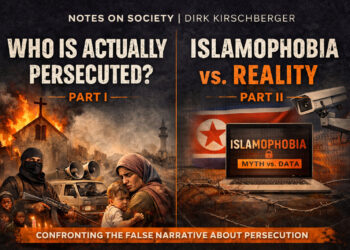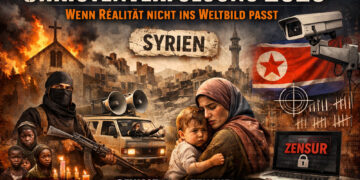


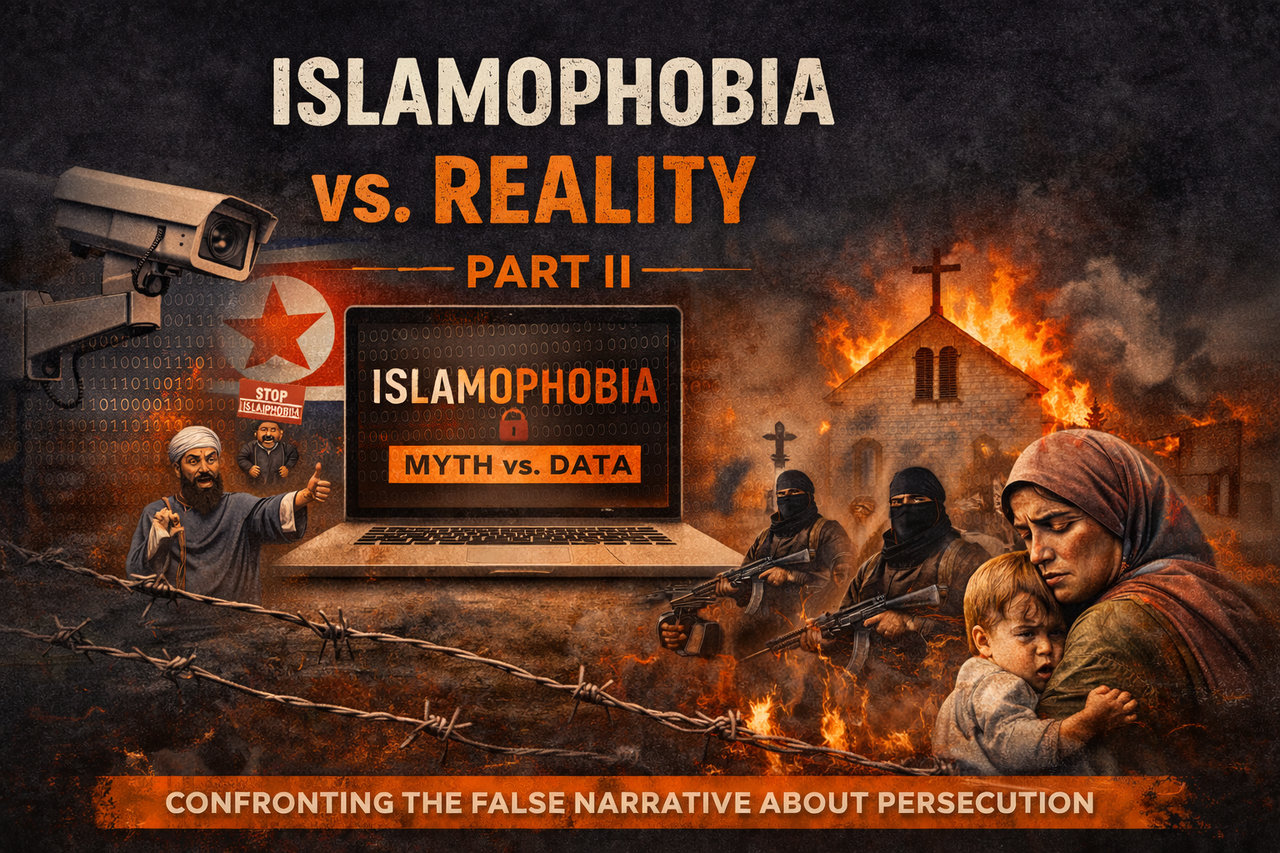
In the modern West, few accusations are as powerful as Islamophobia.
It is treated not as a claim to be examined, but as a verdict — ending debate before it begins.
Yet when accusations replace analysis, the first casualty is truth.
So let us do what the accusation itself avoids: compare claims with reality.
Persecution Has a Definition — and a Paper Trail
Religious persecution is not hurt feelings, criticism, or uncomfortable debate.
It is measurable harm:
- imprisonment for belief
- forced conversion
- destruction of places of worship
- exclusion from education and work
- violence, abduction, and murder
According to Open Doors, Christians face systematic persecution in over 50 countries, with 15 classified as extreme.
There is no equivalent global dataset showing Muslims being persecuted as Muslims at anything close to this scale.
Not because researchers refuse to look — but because the evidence is not there.
Where the Islamophobia Argument Collapses
When Western commentators speak of “Islamophobia,” they usually refer to:
- criticism of religious doctrine
- debate about political Islam
- scrutiny of extremism
- cultural or social conflict
None of these constitute persecution.
In contrast, in many countries:
- converting from Islam is criminalized or punished by death
- Christians are denied legal protection
- churches are burned or shut down
- families are threatened into silence
This is not rhetorical asymmetry.
It is structural asymmetry.
The Category Error at the Heart of the Debate
Islamophobia claims treat dominant religions as if they were global minorities.
But globally speaking:
- Islam is not marginalized
- Islam is not suppressed
- Islam is not facing systematic eradication
In many of the world’s worst persecution zones, Islam is the majority religion, often embedded in law or governance.
That alone makes the comparison intellectually indefensible.
Why the Narrative Persists Anyway
The “Islamophobia” framework serves three functions:
- Moral inversion — turning scrutiny into oppression
- Deflection — shifting attention away from victims who disrupt ideological comfort
- Silencing — making data socially unacceptable
Christians, particularly outside the West, are the wrong kind of victims.
They complicate preferred narratives.
So they are ignored.
The Uncomfortable Conclusion
If concern for persecution were genuine, attention would follow evidence.
It does not.
Instead, Western societies obsess over hypothetical hatred while real persecution unfolds — quietly, relentlessly, and largely unreported.
This is not compassion.
It is selective morality.
And selective morality is not a defense of human rights — it is their betrayal.
Author · Journalist · Strategist
German-born author with a professional background in journalism, investigative research, and strategic communication.
The Tolerance Trap
How the West Lost Its Convictions — and the Courage to Defend Them.
A fearless essay on how tolerance became a moral dogma — and why democracy
cannot survive without the courage to disagree.
“A civilization that calls itself tolerant will not tolerate the question: what if tolerance itself has become a lie?”
“When every opinion must be approved before it can be spoken, freedom no longer needs a prison — only applause.”
“We have replaced truth with empathy, and now we wonder why no one dares to speak.”